Community Action Partnership Convenes with Congressman Chris Pappas Amongst Government Shutdown
Press Release, October 17, 2025
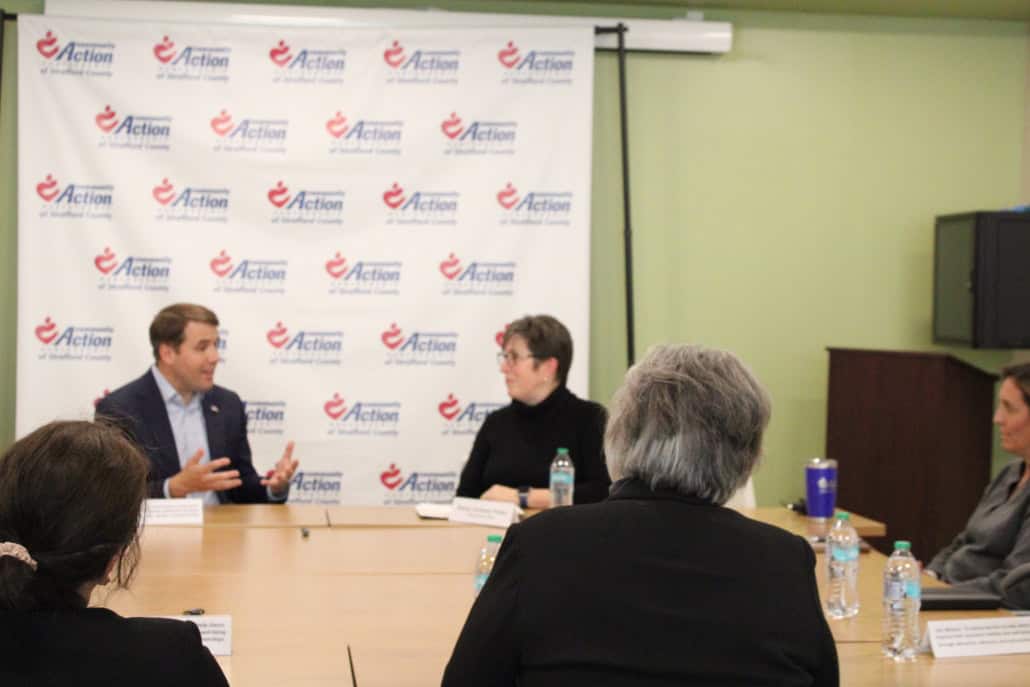
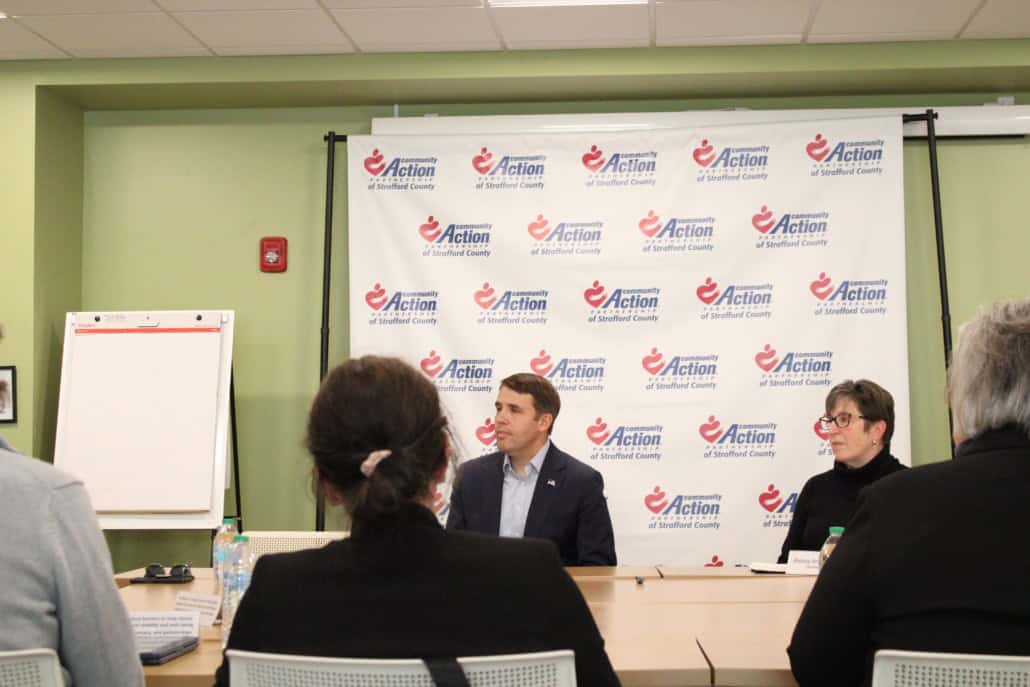
On October 7, 2025, Community Action Partnership of Strafford County (CAPSC) convened a critical roundtable meeting with community partners at its main outreach office in Dover. The meeting included a discussion with Congressman Chris Pappas on how the ongoing government shutdown threatens essential funding for several community organizations and highlighted the need for advocacy around policies such as subsidized healthcare.
“In some ways, I regret that I’m here and not in Washington at this very moment because I would hope that we could be finding a way forward with greater certainty with respect to government funding and to deal with issues like health care that we know are lived issues that impact everyone in the state of New Hampshire,” Congressman Pappas addressed the room full of nonprofit leaders, employees, and community changemakers. “But clearly we need to reopen the government in a responsible manner that funds the programs that people here depend on and make a difference in their lives, while not ignoring the issue of health care, which is getting to a crisis point.”
“I’m really afraid of how the Medicaid cuts are going to be implemented in New Hampshire, based on the estimates that tens of thousands of people could lose access to care at a time when we need to do so much more to connect people with care and services in this state,” Congressman Pappas added.
Throughout the meeting, CAPSC representatives and community partners voiced their concerns about how the shutdown threatens nonprofits and community organizations across New Hampshire. Several leaders also raised alarms about a possible rise in healthcare premiums due to the expiration of the Affordable Care Act (ACA) tax credits, introduced in 2019 during the COVID-19 pandemic.
“At the end of this year, the ACA [Affordable Care Act] premiums are expiring; that’s a whole other burden that’s going to be placed on those that are just above Medicaid eligibility but still are struggling economically to be able to afford the insurance that they need for their family,” Congressman Pappas said. “And what family can experience a $10,000 or $15,000 increase in their health insurance premiums and still carry that policy? It’s next to impossible.”
Chief Executive Officer of CAPSC, Betsey Andrews Parker, advocated for the ACA healthcare offered in New Hampshire—known as the Marketplace—which has allowed nonprofits like hers to provide employees with quality healthcare plans at affordable rates.
“There are several nonprofits across the state of New Hampshire that went into Marketplace in Strafford County,” Andrews Parker said. “There were three big nonprofits that, for the first time, were able to offer affordable, good health insurance. We are going to see some of the premiums
rise 100 percent for some of those individuals, which will make it absolutely impossible to be able to provide good quality health insurance.”
Beyond concerns over changing healthcare premiums, Andrews Parker also advocated for several CAPSC programs she described as “vital” and reliant on discretionary federal funding.
“We are very concerned about a lot of our housing programs that are supporting folks with rental assistance, permanent supportive housing, human trafficking—all of these vital, vital services that have to go on whether there is funding or not. And I just don’t know where we are going to get the funding to support that,” Andrews Parker said.
As Strafford County’s Community Action Agency (CAA), CAPSC provides a full suite of resources and services to those in need, securing funding through a variety of sources including federal grants, local donations, fundraisers, and more. According to Andrews Parker, supporting these services can cost up to $2 million each month.
“How will I find $2 million a month to reimburse for that work that we have done?” Andrews Parker asked Congressman Pappas.
In response, Congressman Pappas reflected on past government shutdowns. In the last 50 years, the United States has experienced 21 shutdowns.
“I remember back in 2019 during the shutdown where there was some legislative work that was needed post-shutdown to ensure that all contractors, that all employees, including furloughed employees, would get paid—and that passed Congress. And I think there’s interest across the board in making sure that that’s the precedence that gets followed here,” Congressman Pappas said.
“And I know we’re prepared to follow legislation on a number of different fronts—whether it’s trying to make sure that programs continue to move forward, making sure that contracts are upheld, making sure that workers get paid. So, we’ve got a lot of different bills that I think are ready to go, and if we were back in session, we’d be offering this stuff on the floor right now,” Congressman Pappas added.
Highlighting the unprecedented nature of the current shutdown, Andrews Parker noted the long-term implications and thanked local partners for their continued support.
“The reality of all of this is starting to set in and hit us, as well as what we see will have to be some decisions down the road—and we are thankful for our state partners as well,” she said.
“We have full faith that everything is going to come back, but we are seeing some of the priorities are shifting. We are seeing a shift away from evidence-based practice. We are seeing a shift away from the harm reduction mode. We are just seeing a shift towards a more punitive model, and we know that these things do not work for keeping people happy and safe and housed. And so that is another concern that we have—that the money will come with some significant strings attached,” Andrews Parker concluded.
“At some point, we’re going to see a breakdown in systems to reach the people that we need to reach, so I’m kind of fearful of the dynamics that are in play right now in Washington,” Congressman Pappas said in response. “We’ve got to get this shutdown off the table, but there’s so much more work to do than that to make sure that we’re moving in the right direction.”
The roundtable meeting was convened in the conference room at the CAPSC central office in Dover located at 577 Central Ave. More information about the work done by CAPSC is available at https://straffordcap.org/misssion-and-vision/.
About Community Action Partnership of Strafford County
Community Action Partnership of Strafford County is a 501(c)(3) private nonprofit organization established under the provisions of the Equal Opportunity Act of 1964 and was founded locally in Strafford County in 1965. The mission of Community Action Partnership of Strafford County is to reduce barriers to help clients improve their economic stability and well-being through education, advocacy, and partnerships. While holding the vision to eliminate poverty, Community Action Partnership of Strafford County (CAPSC) also works to hold values of communication, collaboration, client-focus and accountability through all its local efforts. CAPSC remains the sole provider of a fleet of programs and services that are designed to promote the welfare of all people experiencing low incomes. CAPSC employs nearly 150 people across its offices in Dover, Farmington, Rochester, and Somersworth. More information can be found at straffordcap.org. As of 2025, CAPSC currently has nearly 16,000 unique enrolled individuals in at least one of our programs.
CAPSC Mission and Vision
Founded in 1965, CAPSC is the sole provider in Strafford County to offer a full suite of programs and services designed to have a measurable impact on the health and welfare of at-risk children, seniors, and people experiencing low incomes.
Without the services provided by our agency, many local residents would be without a means to provide for their basic needs, including food, education, child care, utilities assistance, transportation, housing, emergency shelter and access to other services.
Read more here.